 Athena Sols Team
The AI Agent Explosion Is Happening Right Now
Every founder in 2026 is hearing the same pitch: "You need AI agents." The hype is real — but so is the opportunity. Gartner predicts that 40% of enterprise applications will feature task-specific AI agents by the end of 2026, up from less than 5% in
2025. That is an
8x increase in a single year.Nvidia reports that inference compute demand grew 340% year-over-year through Q1
2026. A Gartner CIO survey found that
61% of enterprise technology budgets are now explicitly earmarked for agentic AI deployment. Anthropic, OpenAI, and Google DeepMind have all shifted their primary product roadmaps from raw model benchmarks toward agent reliability, tool use, and multi-agent coordination.The question for non-technical founders is no longer "Should I use AI agents?" — it is "Should I build them custom or buy them off-the-shelf?" This guide gives you a practical decision framework with real cost data.
1. The 2026 AI Agent Landscape: What Actually Changed
In 2024, "AI agent" usually meant a chatbot with a system prompt. In 2026, it means something fundamentally different: autonomous systems that reason, plan, use tools, and take multi-step actions across your CRM, databases, payment systems, and APIs.
The shift from assistants to agents is the defining technology change of
2026. Here is how the two differ:
| Capability | AI Assistant (2024) | AI Agent (2026) |
|---|---|---|
| Autonomy | Waits for human input | Plans, executes, and self-corrects autonomously |
| Tool Use | None or limited API calls | Calls APIs, databases, file systems, payment gateways |
| Multi-Step Reasoning | Single prompt → single response | Chains of thought with branching, retries, and error recovery |
| Collaboration | Standalone | Multi-agent orchestration (agents delegating to other agents) |
For a deeper look at how agentic workflows are changing software development itself, read our August 2026 AI development trends analysis.
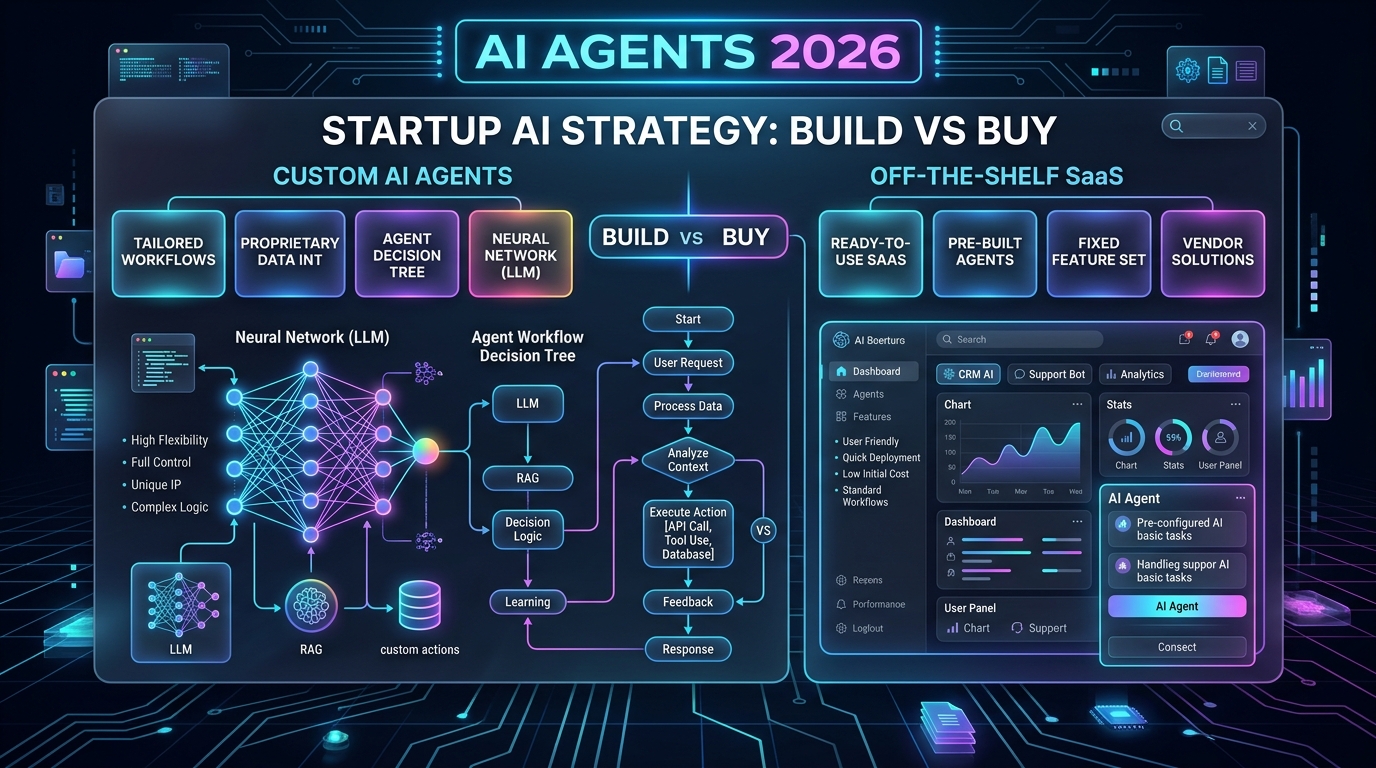
2. The Build vs. Buy Decision Framework
The answer is almost never pure "build" or pure "buy." The most successful startups in 2026 use a workflow-by-workflow scorecard. For each AI-powered workflow in your product, ask these four questions:
- Is this workflow my competitive advantage? If yes → build custom. If no → buy or compose.
- Does it require my proprietary data? If yes → build custom. If no → a platform agent can handle it.
- Does it need strict compliance or audit trails? If yes → build custom with governance. If no → no-code may suffice.
- How fast do I need it live? If days → no-code. If weeks → custom MVP. If months → you are overscoping.
| Approach | Cost | Timeline | Best For |
|---|---|---|---|
| No-Code Agent Platforms | $4k–$20k | Days to 2 weeks | FAQ bots, ticket routing, scheduling, CRM hygiene |
| Custom AI Agent MVP | $25k–$150k | 6 weeks to 4 months | Proprietary workflows, compliance, vertical AI |
| Hybrid (Recommended) | $12k–$50k | 6 weeks | Buy the platform, build the differentiation layer |
3. Vertical AI Wins Over Horizontal: Where the Money Is
The biggest mistake founders make in 2026 is building another generic chatbot. The market is oversaturated with writing assistants, basic customer support bots, and resume builders. These categories have been absorbed by incumbents.
The startups winning investment and revenue are building vertical AI agents — specialised systems that solve specific, high-value workflows in narrow industries:
- Legal: Harvey (valued at $3B+) builds AI that understands case law, not just language
- Healthcare: Ambience AI automates clinical documentation with HIPAA-compliant agents
- Finance: AI-driven credit risk agents that encode specific underwriting logic
- Real Estate: Property valuation agents that integrate with MLS data feeds
- Logistics: Route optimisation agents that factor in real-time customs and weather data
The pattern is clear: your moat is not the model — it is your domain expertise embedded in agent behaviour, your industry-specific tool integrations, and the customer trust relationships you build. AWS provides the infrastructure, but Salesforce and Workday built massive businesses by owning the domain layer.
4. The Technical Architecture a Non-Technical Founder Should Demand
You do not need to write code, but you do need to know what good AI architecture looks like so you can hold your development partner accountable. Here is what to demand:
- Model-agnostic middleware: Use the Vercel AI SDK or similar abstraction so you can swap between Claude, GPT, and Gemini without rewriting your codebase.
- Guardrails before features: The best AI startups in 2026 spend 3x more engineering time on error handling, human-fallback paths, and output validation than on the core reasoning logic.
- Structured output validation: Every AI response should be parsed through schema validation (Zod, Pydantic) before it touches your database.
- Observability from day one: Log every agent action, token count, latency, and failure. You cannot optimise what you cannot measure.
- Human-in-the-loop escape hatches: For any high-stakes decision (payments, legal, compliance), the agent should escalate to a human rather than act autonomously.
5. Pricing Your AI Agent Product: Per-Task Beats Per-Token
Successful early-stage agent startups in 2026 are moving toward per-task or value-based pricing ($500–$5,000/month) rather than token-based billing. Enterprise clients value reliability over cost savings — they will pay more for an agent that works correctly 99% of the time than one that is cheap but fails unpredictably.
When building your MVP, ensure your architecture supports usage tracking and outcome measurement from the start. Your investors in 2026 will ask for demonstrable ROI from live deployments, not demo-day prototypes.
Ready to Build Your AI Agent MVP?
At Athena Sols, we build custom AI agent architectures with model-agnostic middleware, structured output validation, and production-grade guardrails — delivered in 6 weeks at fixed pricing. Serving founders in the US, UK, Germany, UAE, and worldwide.
Book Your Free AI Strategy CallFrequently Asked Questions
What percentage of enterprise apps will have AI agents by end of 2026?
According to Gartner, 40% of enterprise applications will feature task-specific AI agents by the end of 2026, up from less than 5% in
2025. This represents an 8x increase in AI agent adoption within a single year.
How much does it cost to build a custom AI agent for a startup?
A custom AI agent MVP typically costs $25,000 to $150,000 and takes 2 to 4 months of engineering. No-code agent platforms can reduce this to $4,000–$20,000 for commodity workflows, but lack the customisation needed for differentiated products.
When should a startup build custom AI agents vs. buying off-the-shelf?
Build custom when the AI workflow is your competitive advantage, requires deep integration with proprietary data, or needs strict compliance. Buy off-the-shelf for commodity tasks like customer support triage, meeting scheduling, or CRM data entry.
What is the hybrid approach to AI agents?
The hybrid model uses no-code platforms for the 80% of commodity workflows (FAQ handling, ticket routing, scheduling) while building custom-engineered agents for the 20% of high-stakes, differentiated logic (fraud detection, compliance reasoning, proprietary pricing models). Most successful enterprises in 2026 run this pattern.