It was 11 PM on a Saturday — the night of a long-awaited product launch — when Ahmed's development team discovered the problem. A flash sale had gone live on their e-commerce platform, traffic spiked, and the five-year-old PHP backend buckled under the load. Transactions were failing. The checkout page returned a blank screen. By the time the team patched the server and brought things back up, three hours had passed. They had lost an estimated PKR 900,000 in sales, and their social media was full of frustrated customers.
Ahmed's platform hadn't been hacked. There was no dramatic failure. The system had simply aged past the point where it could serve a growing business. And the painful truth — the one Ahmed had been avoiding for two years — was that the warning signs had been there all along.
At Athena Sols, we work with businesses like Ahmed's every month. The question we hear most often isn't "should we migrate?" It's "can we afford to?" The better question, almost always, is: can you afford not to?
The Hidden Cost of Doing Nothing
Legacy code carries what engineers call technical debt — the accumulated cost of shortcuts, outdated dependencies, and architectural decisions made years ago for a business that no longer exists in the same form. Like financial debt, it compounds. Unlike financial debt, it rarely appears as a single line on your P&L.
Instead, it shows up in subtler ways: a developer who spends two days tracking down a bug that should take two hours; a new feature that takes three weeks because it has to thread carefully through a spaghetti codebase; a server bill that keeps creeping up because the application was never optimised for cloud infrastructure.
- Developer teams working on legacy systems spend an average of 42% of their time on maintenance — not building new features
- Fixing a bug in legacy code costs 3–5× more than fixing the same bug in a modern, well-structured codebase
- Businesses running legacy infrastructure report that 60% of their IT budget goes to keeping existing systems alive rather than innovating
None of these costs appear on an invoice. All of them are real.
What a Migration Actually Costs — and What You Get Back
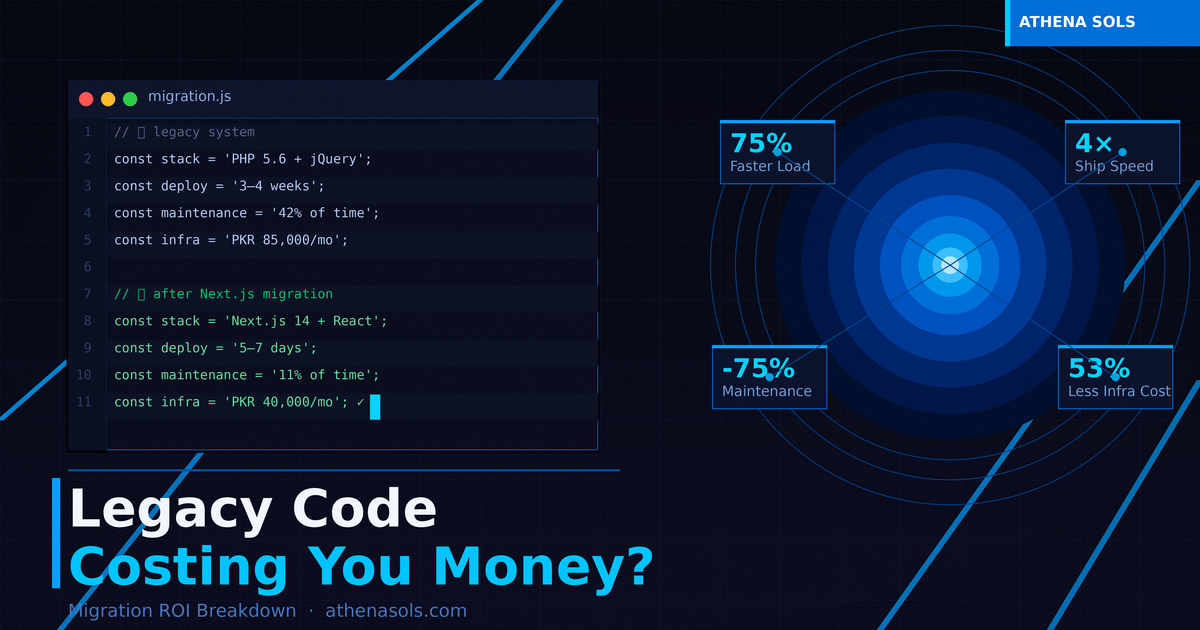
Let's put numbers on this. The following is a realistic ROI breakdown for a mid-sized Pakistani business migrating from a monolithic PHP and jQuery system to a modern Next.js stack — the kind of project Athena Sols handles regularly.
| Category | Before Migration | After Migration | Impact |
|---|---|---|---|
| Monthly developer maintenance hours | 60 hrs | 15 hrs | −75% |
| Average time to ship a new feature | 3–4 weeks | 5–7 days | 4× faster |
| Page load speed | 4.8s | 1.2s | 75% faster |
| Monthly infrastructure cost | PKR 85,000 | PKR 40,000 | −53% |
| One-time migration investment | PKR 600,000 – 1,200,000 | Upfront cost | |
| Estimated payback period | 8–14 months | Break-even point | |
One of our clients — a logistics company in Lahore — was spending 15 developer hours per week just keeping their old dashboard stable. After migrating to a React and headless CMS architecture, that number dropped to under three hours. Twelve hours a week, reclaimed for building new features and growing the product.
The Performance–Revenue Connection
Slow websites don't just frustrate users. They cost money in a well-documented, measurable way. A one-second delay in page load time can reduce conversions by up to 7%. For a business doing PKR 1,000,000 in monthly online revenue, that's PKR 70,000 per second of unnecessary load time — every single month.
Legacy systems commonly fail Core Web Vitals thresholds, which directly impacts Google search rankings. Lower rankings mean less organic traffic. Less traffic means less revenue. The cascade is quiet, consistent, and entirely avoidable.
A typical legacy pattern we encounter is loading an entire monolithic JavaScript bundle on every page — even pages that don't need most of it. Modern frameworks like Next.js solve this automatically through code splitting:
// Legacy approach — loads 2.4MB of JS on every single page
<script src="/static/app.bundle.js"></script>

// Next.js approach — only loads what each page actually needs
const Dashboard = dynamic(() => import('../components/Dashboard'), {
  loading: () => <Spinner />,
  ssr: false,
});
This single architectural change, applied consistently across a codebase, can reduce initial page load by 40–70%. That is not a developer vanity metric. It is a direct input to your bounce rate, session duration, and conversion rate.
Hiring, Retention, and the Talent Cost Nobody Talks About
Here is a migration cost that almost never appears in a spreadsheet: developer misery. Talented engineers do not want to spend their careers maintaining legacy systems. When your stack is outdated, you face a three-sided talent problem — it is harder to recruit, harder to retain, and the developers who stay may not be the ones with the most options elsewhere.
In Pakistan's rapidly growing tech talent market, the difference between offering modern tooling — React, Next.js, TypeScript, AI-assisted development workflows — and a legacy PHP monolith can be the deciding factor for a senior hire. Your technology stack is part of your employer brand, whether you think of it that way or not.
Migrating your stack sends a clear signal to candidates: this is a team that cares about craft, moves quickly, and invests in the right tools. That signal has real recruiting value, and it is free once the migration is done.
How to Know You're Ready to Migrate
Not every legacy system needs a full rewrite. Some can be incrementally modernised. Others are so deeply coupled that a phased migration is the only realistic path. The right approach depends on your codebase, your team, and your business timeline. But there are clear signals that the conversation needs to happen now:
- Your developers regularly say "that's just how the system works" when asked why something takes so long
- New features consistently take longer than estimated because of unexpected dependencies
- You have experienced at least one major outage or data issue in the past 12 months
- Your platform fails Core Web Vitals and you have seen organic traffic plateau or decline
- Senior engineers have left — or expressed frustration — because of the tech stack
If three or more of these are true, the ROI case for migration is almost certainly compelling. The question is not whether to move — it is when, and how to do it without disrupting your operations.
At Athena Sols, we approach migrations in phases. Your existing system stays live throughout. We build the new architecture in parallel, migrate data incrementally, and cut over only when the new system is tested, stable, and signed off. Businesses don't go offline. Teams don't stop shipping.
Conclusion
The cost of legacy code is not a future problem. It is a present one — showing up today in slower features, higher maintenance bills, frustrated developers, and missed revenue. The longer it compounds, the more expensive the eventual fix becomes.
Migration is an investment, not an expense. The payback period for most mid-sized projects is under 14 months. After that, everything — faster delivery, lower infrastructure costs, better performance, happier engineers — is pure return.
Ahmed's business, after a full migration to a Next.js storefront with a custom React dashboard, shipped their next product launch without a single incident. Traffic spiked. The system held. The team slept through the night.
That is what a modern stack buys you — not just better code, but confidence that your technology can keep up with your ambitions.
Ready to find out what migration could mean for your business?
Book a free 30-minute discovery call with the Athena Sols team. We'll review your current stack, identify the highest-impact migration opportunities, and give you a clear, honest picture of timeline, cost, and ROI — no jargon, no pressure.
Talk to Athena Sols →