A founder of a fintech startup in Lahore came to us six months after launching his mobile app with a problem that is more common than most people admit: the downloads were there, but the conversions were not. After eight months on the market, 68% of users who downloaded the app never completed registration. Of those who did register, fewer than one in five returned after the first session. His development team had built everything on the brief — all the features were there, the app worked, and the App Store ratings were not embarrassing. But the business metrics told a different story. The app was technically functional and commercially invisible at the same time.
If you are a business owner, CTO, or marketing manager who has invested in a mobile app and is not seeing the user conversions your projections assumed, the problem is almost never what you think it is. It is rarely a marketing problem — more downloads will not fix a leaky funnel. It is rarely a features problem — more functionality often makes things worse. In most cases, the issue comes down to three specific, fixable failures in how the app was built and structured. Here is what they are, and what it actually takes to address them.
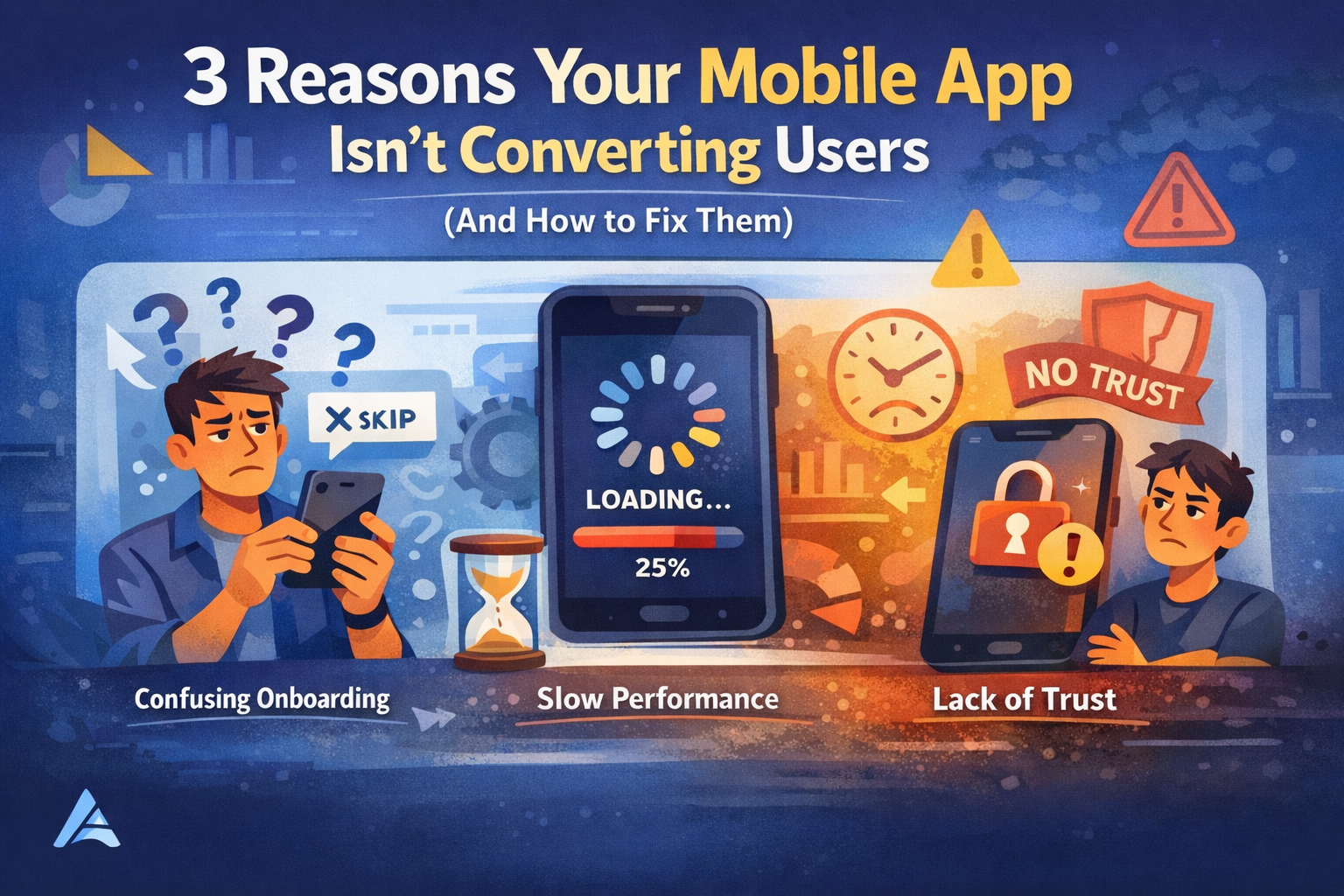
Reason 1: Your Onboarding Flow Is Losing Users in the First 60 Seconds
The moment a user opens your app for the first time is the highest-stakes moment in your entire user relationship. Research from Localytics shows that 25% of apps are used only once after download. The reason is almost always the same: the app failed to deliver a clear, immediate sense of value before asking the user to do something — fill out a form, grant permissions, create an account, set up a profile.
Most onboarding flows are designed around what the business needs to know, not what the user needs to experience. The result is a gauntlet of screens — email, password, phone number, date of birth, notification permissions, location permissions, profile photo — before the user has seen a single reason to care. Every additional screen in an onboarding flow is a door that some percentage of users will walk out of and never return through.
The fix is to invert the logic entirely. Show value first. Ask for the minimum. Defer the rest. The best onboarding flows in the market today get a user to their first meaningful interaction in under three taps, collecting only what is strictly necessary to personalise the experience. Profile completion, permission requests, and preference setting come later — after the user has experienced enough of your app to have a reason to invest time in it. Apps that adopt this approach consistently see first-session completion rates improve by 30 to 50 percent.
Reason 2: Your App Is Too Slow to Hold Attention
Mobile users are less patient than desktop users and significantly less forgiving. Google's data shows that 53% of mobile users abandon an app or mobile site if it takes more than three seconds to load a key screen. For transactional interactions — adding to cart, submitting a form, completing a payment — even a one-second delay can reduce conversion by 7% or more. These are not edge cases. They are the normal behaviour of normal users in 2025.
Slow apps are usually the result of one or more of the same underlying issues: unoptimised images loaded at full resolution, API calls that block the interface while waiting for data, heavy JavaScript bundles that take too long to parse and execute on mid-range Android devices, and no caching strategy that would allow previously loaded content to appear instantly on return visits. Each issue on its own is manageable. All of them together — which is the typical condition of an app that was built quickly under deadline pressure — produces an experience that feels frustratingly unresponsive.
The solution is not to throw more server capacity at the problem. It is to architect the app correctly from the start, with performance as a first-class concern rather than something to be optimised after launch. This means virtualised list rendering, intelligent data fetching with local caching, image compression pipelines, and bundle optimisation built into the development workflow. Apps built this way on React Native routinely feel as fast as native iOS or Android applications — because when performance is baked in architecturally, the platform delivers it.
Reason 3: Your App Doesn't Feel Trustworthy
This is the reason most teams do not want to hear, because it implicates decisions made early in the design process that are expensive to reverse. But it is consistently one of the most powerful levers available for improving mobile conversion rates, especially for apps that handle sensitive data, financial transactions, or personal information.
Trust in a mobile app is not built through a single feature or a single design decision. It is the cumulative impression created by dozens of small signals: Is the typography consistent and legible? Do buttons do what they appear to do? When the app asks for location access, does it explain why in plain language — or does a system prompt just appear with no context? Are there visible indicators of security on payment screens? Is there a real company name, a support contact, a privacy policy that is actually readable by a human being?
Apps that skip these details — often because they were cut in the rush to launch — send an unconscious signal to users that something is not quite professional, not quite safe. Users cannot always articulate why they did not complete a purchase or share their credit card details. They just did not feel comfortable. And once that discomfort is felt, no amount of push notifications or discount codes will bring them back. Addressing the trust layer of your app's UX is often the highest-ROI improvement available, because it operates silently on every single user who reaches a conversion point.
What High-Converting Apps Have in Common
After working on mobile products across e-commerce, fintech, services, and SaaS, the pattern is consistent. Apps that convert well share three characteristics that cut across industries and user demographics. They get the user to a moment of genuine value as quickly as possible — before asking for anything. They perform reliably and quickly on the full range of devices their users actually own, not just the high-end phones the development team used for testing. And they communicate trust through every detail of their design, from the first permission request to the final confirmation screen.
These are not expensive features to add to a spec sheet. They are outcomes of a development philosophy — one that centres the user's experience and the business's conversion goals from the first line of planning, rather than treating them as post-launch polish. At Athena Sols, every mobile project we take on begins with a review of these three foundations before any design or development work begins. The result is apps that perform commercially, not just technically.
Ready to Build an App That Actually Converts?
Downloads are a vanity metric. Conversions are the metric that pays salaries and justifies the investment your company made in building a mobile product in the first place. If your app is attracting users but not converting them — or converting them once and failing to bring them back — the three reasons above account for the vast majority of cases we have seen across Pakistan and internationally.
The good news is that none of these problems are permanent. Onboarding flows can be restructured. Performance can be re-architected. Trust signals can be designed in. The question is whether you have a development partner who understands not just how to build a technically functional app, but how to build one that converts.
At Athena Sols, we specialise in building React Native mobile applications, Next.js web apps, AI chatbot integrations, and custom dashboards for businesses in Lahore, across Pakistan, and globally. We build for conversion from day one — not as an afterthought.
If your app is not performing the way your business needs it to, let us have a direct conversation about why. Reach out to our team at athenasols.com/contact — we will review your current app, identify the specific conversion blockers, and show you exactly what a better-built version could deliver for your business.
Your users are making a decision about your app in the first 60 seconds. Make sure you are ready for it.